4 Signs a War Would Reach Your Light Switch Before It Reaches Your Street
In every modern conflict, the power grid is hit first. U.S. officials have already said our grid is being targeted. Here are the four warning signs, and the one thing every family should have in the drawer before the lights go out.
- Since 2022: Russia has hit Ukraine’s power grid again and again, leaving millions of families in the dark in winter. Modern war starts at the substation.
- Jan 2024: the FBI Director told Congress that Chinese state hackers had positioned themselves inside U.S. infrastructure, ready to “wreak havoc and cause real-world harm.”
- Dec 2022: gunfire on two substations in Moore County, North Carolina knocked out power to about 45,000 customers for days.
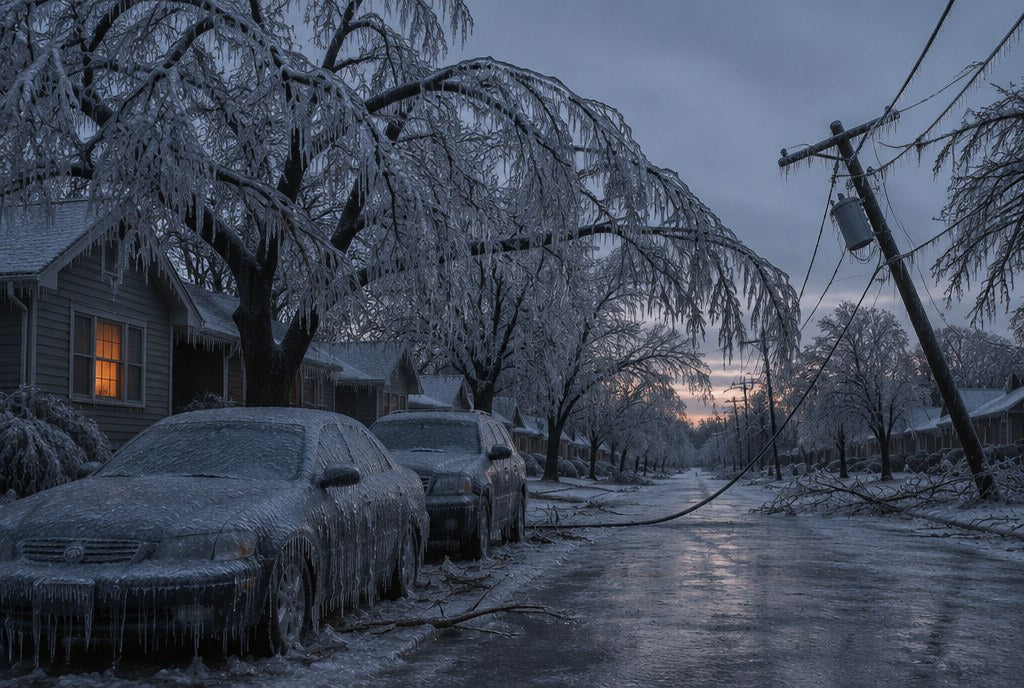
Most Americans picture war as something that happens somewhere else. Tanks on the news. Missiles on a map. Far away.
That picture is out of date. In the wars of the last few years, the first target has not been an army. It has been the power grid. Knock out the power and you knock out water pumps, cell towers, gas stations, hospitals and the phone in every family’s pocket, without firing a shot at a single soldier.
And our own government has told us, in plain words, that America’s grid is already in the crosshairs. You don’t have to be a prepper to take that seriously. You just have to be the man your family calls when something goes wrong.
Sign #1: The grid is the first target in modern war
Look at Ukraine. For years now, wave after wave of strikes has gone after power plants and substations, not just military bases. Millions of ordinary families have lived through rolling blackouts in the dead of winter, charging phones wherever they can find power, because the attacker understood something simple: a country in the dark is a country in chaos.
Every military planner on earth watched that happen. Every one of them learned the same lesson.
Sign #2: Foreign hackers are already inside
In January 2024, the Director of the FBI sat in front of Congress and said that Chinese state hackers had burrowed into American infrastructure, positioning themselves to “wreak havoc and cause real-world harm” when the moment came. A joint warning from U.S. cyber agencies named the energy sector among the targets.
Read that again. This isn’t a theory on a message board. It’s the head of the FBI, under oath, telling the country that the switch is already within reach of a foreign power.
Sign #3: Physical attacks on substations are already happening

You don’t need a foreign army to take down a town’s power. In December 2022, someone opened fire on two substations in Moore County, North Carolina. About 45,000 customers lost power, some for days, in freezing weather. Schools closed. Families huddled in the dark. One attack, one night, a whole county.
If a few rifle rounds can do that to one county, ask yourself what a coordinated attack during a real conflict could do to a region.
Sign #4: The grid has no slack left
Even with no attack at all, the grid’s own reliability watchdog has warned winter after winter that large parts of North America could run short of power in extreme cold. Winter Storm Uri proved it in 2021, when more than 4.5 million Texas homes and businesses went dark.
Put it together: a stretched, aging grid, foreign hackers already inside it, a track record of physical attacks, and a world where the first move in any war is to turn the lights off. When it happens, it will not come with a warning, and it will not be fixed by morning.
What the first 72 hours look like
Hour 1: the lights go out. Everyone reaches for their phone. Cell service may still work for a while on tower backup batteries.
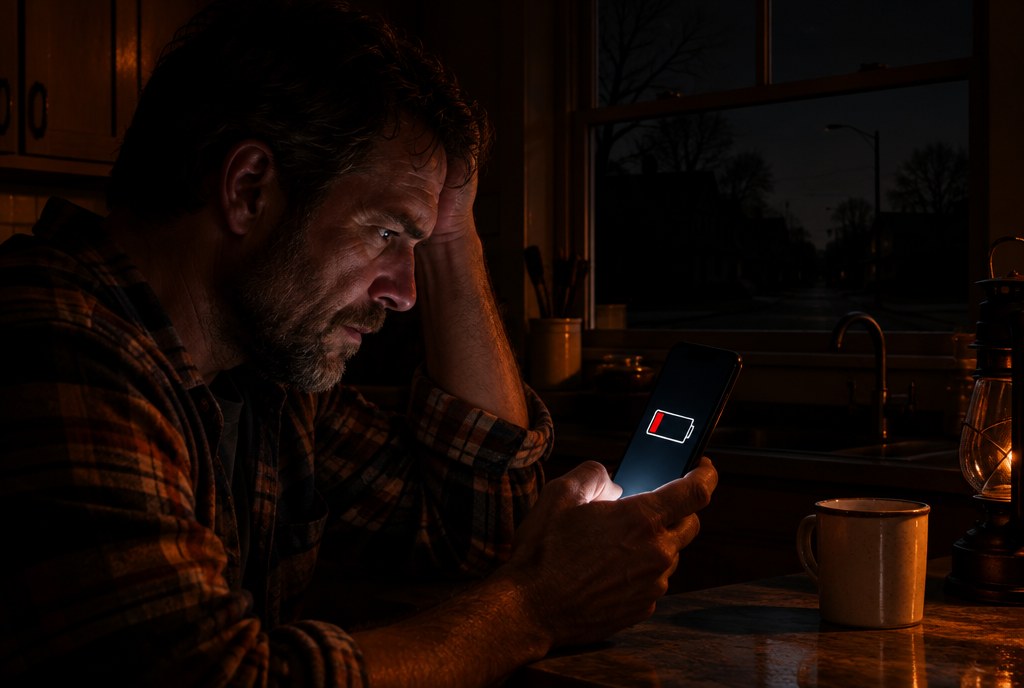
Hour 12: phones are at half. You are using yours as a flashlight, a radio and a news feed. The regular power bank in the junk drawer gets one phone back to full. Then it is dead too.
Hour 36: the phones in your house are dying one by one. Your mother across town has stopped answering. Your kid’s phone went dark at a friend’s house. Gas stations can’t pump without power, so the car charger is out.
Hour 72: the families still in contact with each other are the ones who planned for this one specific thing: power that doesn’t need the grid.

- Buy 2, get 1 free: 3 power banks for $109.99 ($36.66 each)
- Buy 3, get 2 free: 5 power banks for $164.99 ($33.00 each)
- 90-day money-back guarantee on every order
Ships with tracking · Ends Nov 30, 11:59 PM CT
Why most backup plans fail on day two
Almost every house has some kind of backup. The trouble is that nearly all of it depends on the one thing that just went away.
- Wall chargers need the grid. Useless the second the lights go out.
- Regular power banks give you one refill. Then they need an outlet to recharge, and there isn’t one.
- Car chargers need gas and a running engine. Idling in a closed garage can kill you, so you end up sitting in the driveway in the cold.
- Generators are great for the fridge. They are also loud, need fuel you may not be able to buy, must run outdoors, and do not fit in your pocket or go to your mother’s house.
- Low Power Mode buys you hours, not days.
What actually works is simple: power you charge ahead of time, keep within reach, can carry in one hand, and can top up without an outlet if the outage drags on. That is the job we built Rivanta for.
What Rivanta is, and what it isn’t

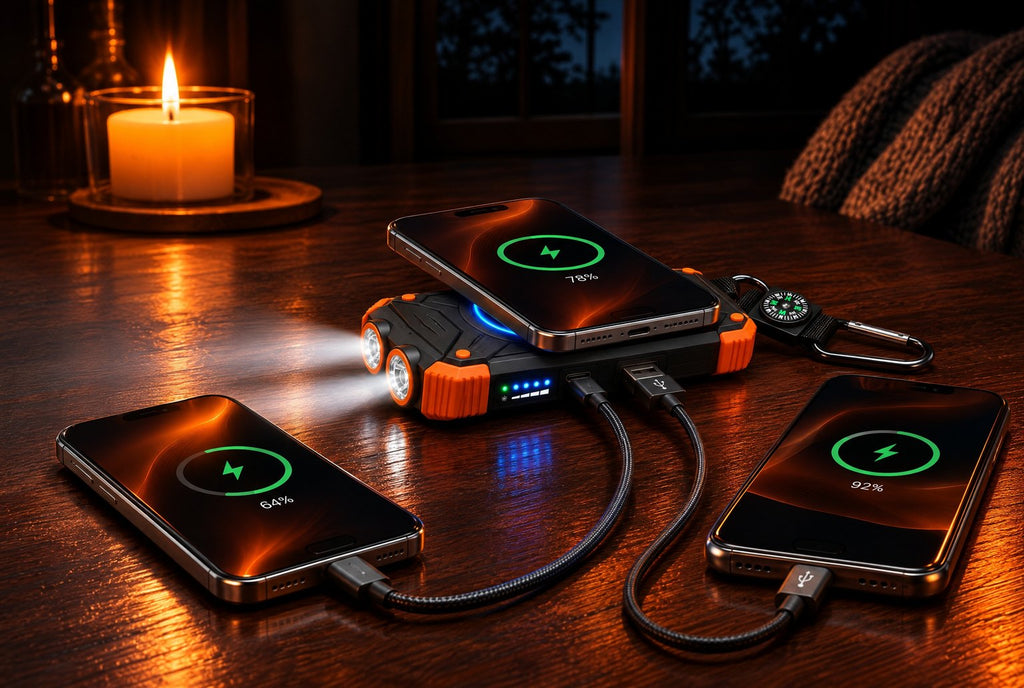
- 10,000 mAh (37 Wh): about 2 to 2.5 full charges for most iPhones and Galaxy phones
- 3 devices at once: USB-C 20W fast charge, USB-A and a Qi wireless pad
- Twin LED flashlight with steady, strobe and SOS modes, so you are not burning your phone’s battery for light
- Built-in solar panel for a slow backup top-up in direct sun when there is no outlet
- Built to be thrown in a truck: rubber corners, IPX4 splash-resistant shell, compass carabiner
- Under the 100 Wh carry-on limit for power banks (check your airline)
| Rivanta | Regular power bank | Generator | |
|---|---|---|---|
| Works with no grid | Yes | Until it runs out | While fuel lasts |
| Refills with no outlet or fuel | Solar top-up | No | No |
| Safe indoors, in your hand | Yes | Yes | Outdoors only |
| Charges 3 devices, incl. wireless | Yes | Usually 1 | With adapters |
| Built-in flashlight + SOS | Yes | No | No |
| Price | From $33 each in a bundle | $20–$40 | $400+ |
Set it up tonight
- Charge it the day it arrives. Top it up every three months.
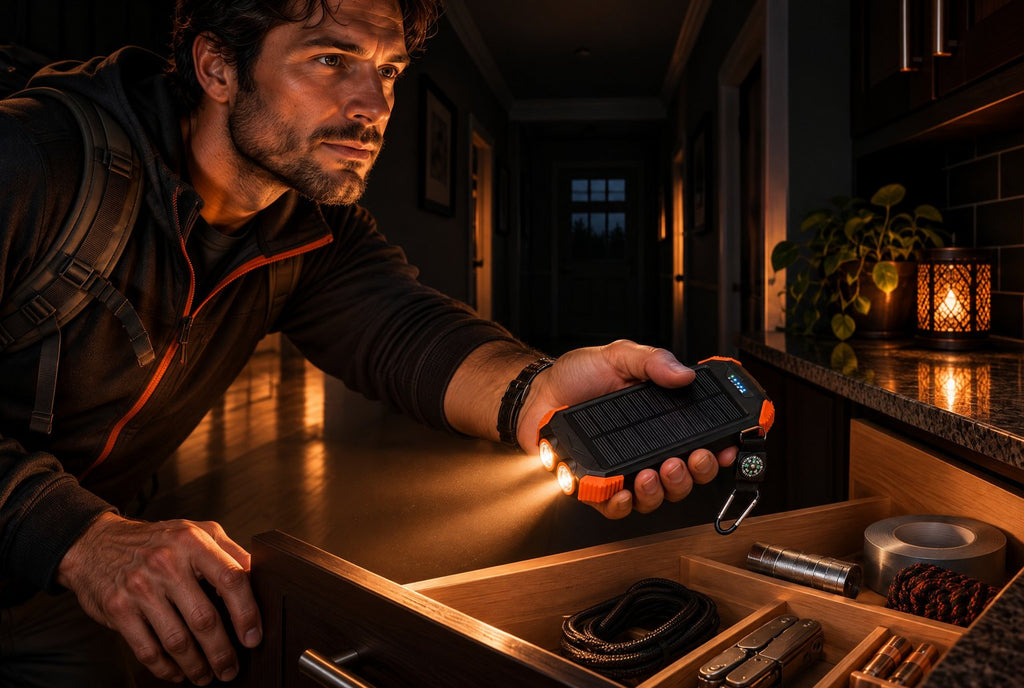
- Keep it where you can find it blind. Kitchen drawer, nightstand, behind the truck seat.
- Put one in every house you’d worry about. Your wife’s car, your parents’ nightstand, your kid’s backpack.
- Run the one-hour breaker test so you know your plan works before you need it.
Black Friday: cover every phone you’d call
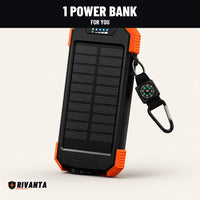 1 Power BankFor you · $54.99 each$54.99
Save 29%MOST POPULAR
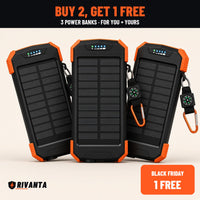 Buy 2, Get 1 FREE3 power banks · $36.66 each$109.99
Save 52%BEST VALUE
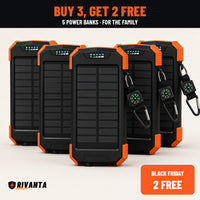 Buy 3, Get 2 FREE5 power banks · $33.00 each$164.99
Save 57%
Tap a bundle to go straight to secure checkout · Ships with tracking · 90-day money-back guarantee
Claim Buy 2, Get 1 Free →90-day money-back guarantee · Black Friday pricing ends Nov 30, 11:59 PM CT
Charge it, use it, switch off your main breaker for an hour and live on it. If it is not for you, send it back within 90 days for a full refund.
90-day money-back guarantee · Black Friday pricing ends Nov 30, 11:59 PM CT


