After Hurricane Helene, the Hardest Part for Many Families Wasn’t the Storm. It Was the Silence.
When power and cell service went down across western North Carolina in 2024, a lot of people were safe but had no way to tell anyone. Here is what that taught us, and the simple fix every household can make before the next one.
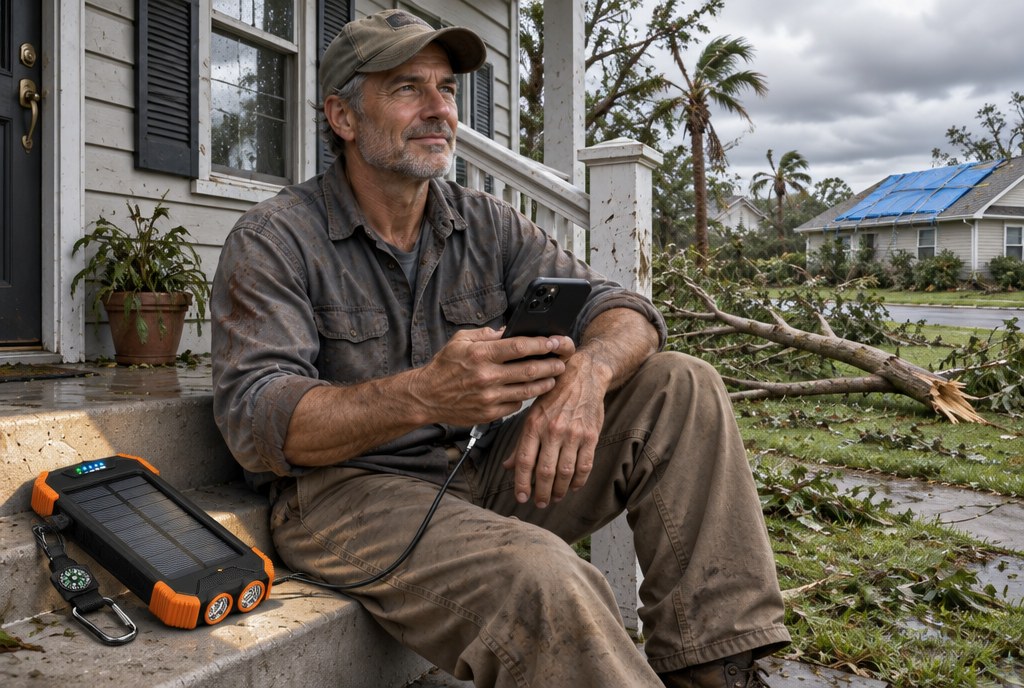
In late September 2024, Hurricane Helene pushed far inland and hit the mountains of western North Carolina with rain those communities had never seen. Rivers jumped their banks. Roads washed out. Power went down for millions of people across the Southeast, and in many mountain towns cell and internet service went with it, for days.
The stories that came out afterward were not mostly about the wind. They were about the waiting. Grown children in other states who could not reach their parents. Parents who knew they were fine but could not tell anyone. Neighbors walking miles to find one bar of signal so they could send a single text: “We’re okay.”
Some of that was out of anyone’s control. When towers are physically damaged, no gadget can fix it. But a lot of the silence had a much simpler cause, and it is one every family can fix tonight.
Why the phones went silent
There were two separate problems, and people often mixed them up.
Problem one: the network. Some towers were damaged or lost their backup power. Carriers brought in portable towers and restored service area by area, and many people found that signal came back days before their power did.
Problem two: the phone itself. This is the one that caught people. By the time signal came back to their area, their phone had been dead for two days. No outlet. No car they could get to. A power bank that had already been drained the first night. The tower was up, and they still could not call.
That is the gap. It is not dramatic, and it is not expensive to close. But almost nobody plans for it, because we are used to a world where there is always an outlet within reach.
What a long outage actually looks like
Day one, you are fine. You used the phone flashlight a bit, checked the news, called family. You go to bed at 40%.
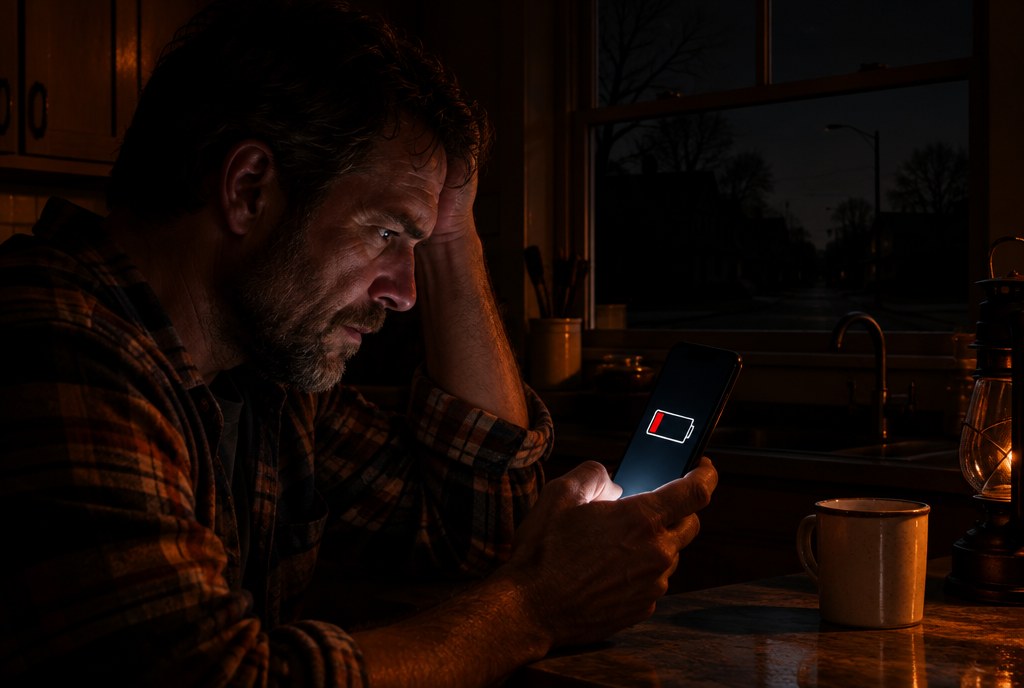
Day two, you start rationing. Low Power Mode, screen brightness all the way down, checking it once an hour. The regular power bank from the junk drawer gives you one refill. Then it is empty too, and it needs an outlet to recharge.
Day three, the phone is dead. Maybe the signal is back, maybe it isn’t. Either way, you have no way to know, and nobody can reach you.
The families who stayed in touch through Helene and storms like it had one thing in common: a way to put charge back in the phone without the grid.

- Buy 2, get 1 free: 3 power banks for $109.99 ($36.66 each)
- Buy 3, get 2 free: 5 power banks for $164.99 ($33.00 each)
- 90-day money-back guarantee on every order
Ships with tracking · Ends Nov 30, 11:59 PM CT
What we would do before the next storm
- Charge every power bank in the house today, and put a reminder on your calendar to top them up every three months.
- Get one that can refill without an outlet. A built-in solar panel is slow, but on day three, slow beats nothing.
- Cover more than your own phone. Your parents, your kids, your partner. It takes two charged phones to make one call.
- Agree on a check-in plan. Texts get through on jammed networks when calls don’t. Pick one out-of-state relative everyone reports to.
- Keep a real flashlight so the phone battery is saved for calls.

Why most backup plans fail on day two
Almost every house has some kind of backup. The trouble is that nearly all of it depends on the one thing that just went away.
- Wall chargers need the grid. Useless the second the lights go out.
- Regular power banks give you one refill. Then they need an outlet to recharge, and there isn’t one.
- Car chargers need gas and a running engine. Idling in a closed garage can kill you, so you end up sitting in the driveway in the cold.
- Generators are great for the fridge. They are also loud, need fuel you may not be able to buy, must run outdoors, and do not fit in your pocket or go to your mother’s house.
- Low Power Mode buys you hours, not days.
What actually works is simple: power you charge ahead of time, keep within reach, can carry in one hand, and can top up without an outlet if the outage drags on. That is the job we built Rivanta for.
What Rivanta is, and what it isn’t

- 10,000 mAh (37 Wh): about 2 to 2.5 full charges for most iPhones and Galaxy phones
- 3 devices at once: USB-C 20W fast charge, USB-A and a Qi wireless pad
- Twin LED flashlight with steady, strobe and SOS modes, so you are not burning your phone’s battery for light
- Built-in solar panel for a slow backup top-up in direct sun when there is no outlet
- Built to be thrown in a truck: rubber corners, IPX4 splash-resistant shell, compass carabiner
- Under the 100 Wh carry-on limit for power banks (check your airline)
| Rivanta | Regular power bank | Generator | |
|---|---|---|---|
| Works with no grid | Yes | Until it runs out | While fuel lasts |
| Refills with no outlet or fuel | Solar top-up | No | No |
| Safe indoors, in your hand | Yes | Yes | Outdoors only |
| Charges 3 devices, incl. wireless | Yes | Usually 1 | With adapters |
| Built-in flashlight + SOS | Yes | No | No |
| Price | From $33 each in a bundle | $20–$40 | $400+ |
Storm sale: get 2 free
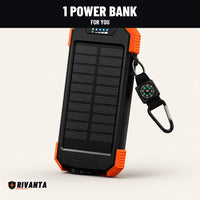 1 Power BankFor you · $54.99 each$54.99
Save 29%MOST POPULAR
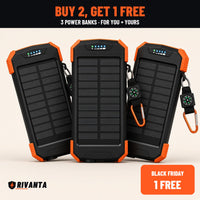 Buy 2, Get 1 FREE3 power banks · $36.66 each$109.99
Save 52%BEST VALUE
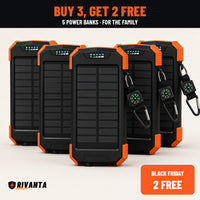 Buy 3, Get 2 FREE5 power banks · $33.00 each$164.99
Save 57%
Tap a bundle to go straight to secure checkout · Ships with tracking · 90-day money-back guarantee
Get my storm bundle →90-day money-back guarantee · Black Friday pricing ends Nov 30, 11:59 PM CT
Charge it, use it, switch off your main breaker for an hour and live on it. If it is not for you, send it back within 90 days for a full refund.
90-day money-back guarantee · Black Friday pricing ends Nov 30, 11:59 PM CT


