The Pentagon Plans for Its Bases to Run Two Weeks Without the Grid. Most American Homes Couldn’t Last Two Days.
The military doesn’t hope the power stays on. It plans for the day it doesn’t. Here is the 6-item list to bring your house up to the same mindset this weekend, and the one item almost every family is missing.
- U.S. Army policy calls for critical missions on its installations to keep running for at least 14 days if the commercial grid fails.
- Jan 2024: the FBI Director warned Congress that foreign state hackers had positioned themselves inside U.S. infrastructure.
- Feb 2021: Winter Storm Uri left more than 4.5 million Texas homes and businesses without power, many for days.
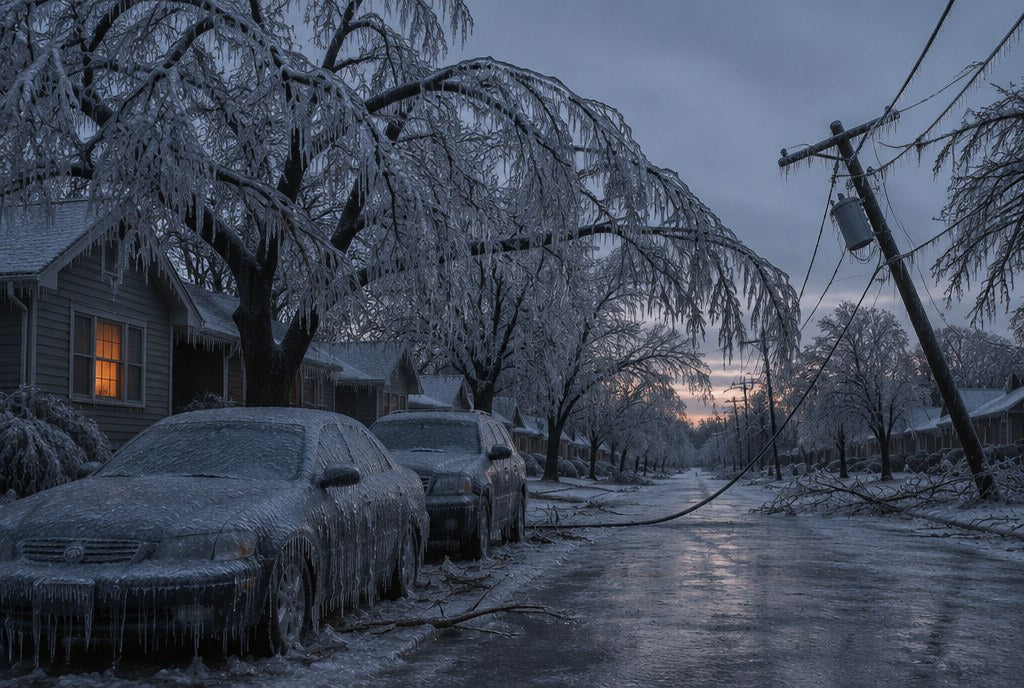
Here is something most people never think about. The U.S. military does not assume the power company will keep the lights on. Army policy calls for the critical missions on its bases to keep running for at least 14 days if the commercial grid goes down. Bases are adding their own solar, batteries and microgrids to make that happen.
Ask yourself why. The people with the best intelligence in the world have looked at the grid, at cyberattacks, at physical attacks on substations, at extreme weather, and decided that two weeks without outside power is a scenario worth planning for.
Now look at your own house. If the power went out tonight, how long until your family is in the dark, out of contact and out of options? For most American homes, the honest answer is about a day and a half.
You don’t need a microgrid. You need six things, five of which cost you nothing. Work through this list this weekend and tick each box.
- Charge everything the moment trouble is forecast
- Stock food you don’t have to cook
- Store water
- Run the one-hour breaker drill
- Set a family comms plan
- One charged solar power bank per person
1. Charge everything the moment trouble is forecast
The military calls it readiness. Phones, laptops, tool batteries, everything goes on the charger the second a storm, a heat wave or bad news is in the forecast. Half the phones in an average house are sitting at 30% when the lights go out. Not yours.
2. Stock food you don’t have to cook
Canned meat, peanut butter, crackers, oats. Eat the fridge first, then the freezer, then the pantry. Keep the fridge door shut.
3. Store water
A gallon per person per day is the common rule. On a well, your pump dies with the power. Fill the tub when trouble is coming so you can still flush.
4. Run the one-hour breaker drill
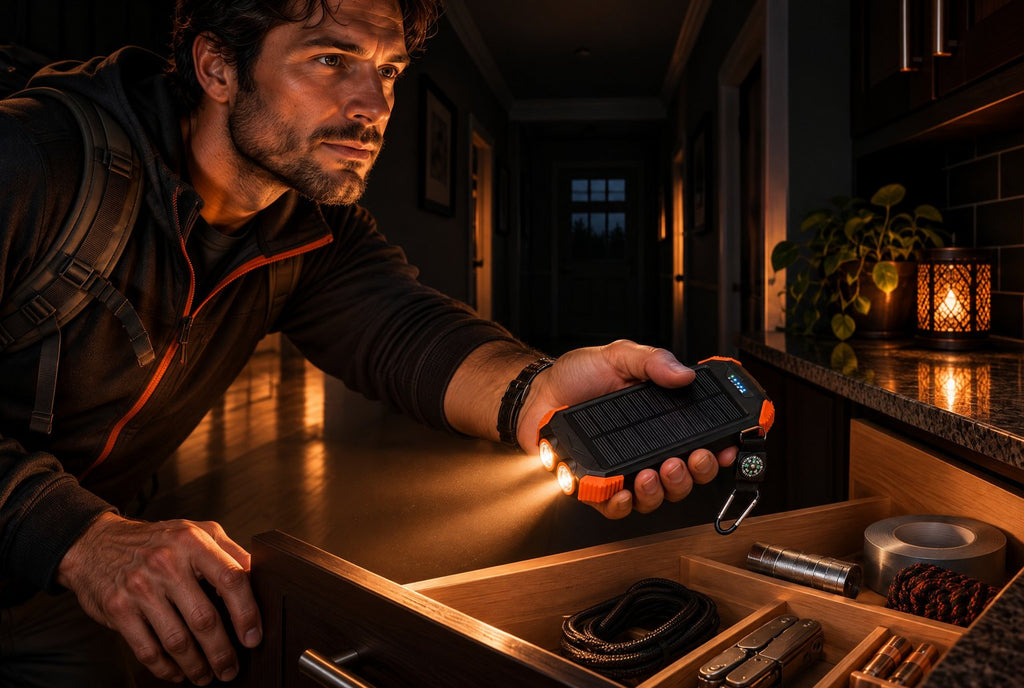
Every unit drills. So should your house. Flip the main breaker off for one hour on a Saturday night. You will find out fast where the flashlights really are, whose phone is already at 20%, and what your plan is missing.
5. Set a family comms plan
Who calls whom, and when. Texts instead of calls, because texts get through on a jammed network. One out-of-state relative everyone checks in with. Write it down and stick it on the fridge.
But a comms plan is worthless if the radios are dead. And in your house, the radios are phones.
6. One charged solar power bank per person
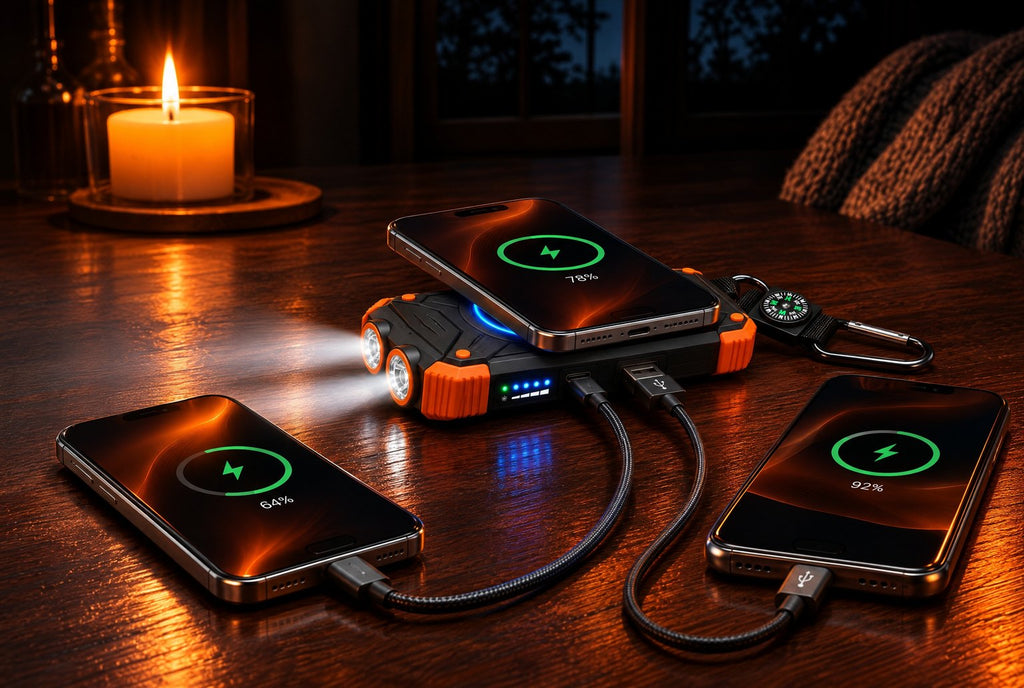
This is the item almost every family is missing, and it’s the one that makes the other five work. Not one for the house. One per person, because it takes two charged phones to make one call.
The right one meets four standards: it works with no grid, it can refill without an outlet or fuel, it’s safe in your hand indoors, and it covers more than one device. Regular power banks fail the second. Generators fail the third. Car chargers fail the first two.
Rivanta was built to that standard: a rugged 10,000 mAh bank with a built-in solar panel for backup top-ups, three ports including a wireless pad, and a twin LED flashlight with SOS. Charge it, drawer it, and it’s ready when the grid isn’t.

- Buy 2, get 1 free: 3 power banks for $109.99 ($36.66 each)
- Buy 3, get 2 free: 5 power banks for $164.99 ($33.00 each)
- 90-day money-back guarantee on every order
Ships with tracking · Ends Nov 30, 11:59 PM CT
What Rivanta is, and what it isn’t

- 10,000 mAh (37 Wh): about 2 to 2.5 full charges for most iPhones and Galaxy phones
- 3 devices at once: USB-C 20W fast charge, USB-A and a Qi wireless pad
- Twin LED flashlight with steady, strobe and SOS modes, so you are not burning your phone’s battery for light
- Built-in solar panel for a slow backup top-up in direct sun when there is no outlet
- Built to be thrown in a truck: rubber corners, IPX4 splash-resistant shell, compass carabiner
- Under the 100 Wh carry-on limit for power banks (check your airline)
| Rivanta | Regular power bank | Generator | |
|---|---|---|---|
| Works with no grid | Yes | Until it runs out | While fuel lasts |
| Refills with no outlet or fuel | Solar top-up | No | No |
| Safe indoors, in your hand | Yes | Yes | Outdoors only |
| Charges 3 devices, incl. wireless | Yes | Usually 1 | With adapters |
| Built-in flashlight + SOS | Yes | No | No |
| Price | From $33 each in a bundle | $20–$40 | $400+ |
Finish item #6: one per person
 1 Power BankFor you · $54.99 each$54.99
Save 29%MOST POPULAR
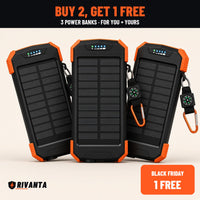 Buy 2, Get 1 FREE3 power banks · $36.66 each$109.99
Save 52%BEST VALUE
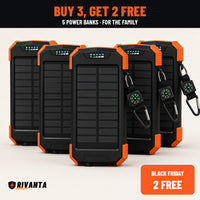 Buy 3, Get 2 FREE5 power banks · $33.00 each$164.99
Save 57%
Tap a bundle to go straight to secure checkout · Ships with tracking · 90-day money-back guarantee
Check off item #6 →90-day money-back guarantee · Black Friday pricing ends Nov 30, 11:59 PM CT
Questions
How long will it keep a phone going?
About 2 to 2.5 full charges for most phones. With Low Power Mode and sensible use that covers several days, and the solar panel stretches it in a long outage.
Will it hold a charge in a drawer?
Yes. Top it up every three months. An easy habit: when the clocks change.
Is it hard to use for an older parent?
Plug the phone in and press the button, or lay the phone on the wireless pad. The flashlight has its own button.
Charge it, use it, switch off your main breaker for an hour and live on it. If it is not for you, send it back within 90 days for a full refund.
90-day money-back guarantee · Black Friday pricing ends Nov 30, 11:59 PM CT


