If the Power Goes Out Tonight, How Long Can Your Family Reach You?
This is not an article about disaster. It is about arithmetic, and you can do it for your own house in two minutes. Most people do not like the answer.
- Feb 2021, Texas: Winter Storm Uri left more than 4.5 million homes and businesses without power, many for days.
- Sept 2024, Southeast: Hurricane Helene cut power to millions; parts of western North Carolina lost cell service for days.
- Every winter since: the grid’s reliability watchdog (NERC) has warned that large parts of North America could run short of power in extreme cold.
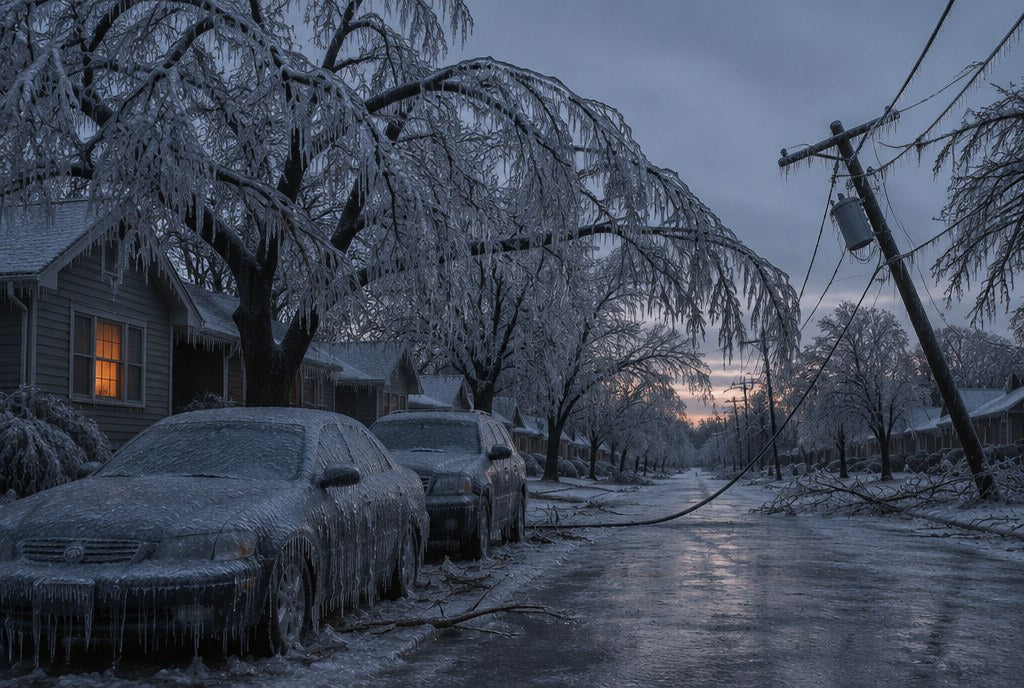
We tend to think about outages in terms of comfort. Will the house stay warm? Will the food in the freezer spoil? Those are real problems. But there is a quieter question that decides how scary an outage actually feels: how long can the people you love reach you, and how long can you reach them?
Let’s work it out.
Work it out for your own house
Step 1: Start with tonight’s battery. Look at your phone. Say it is at 60% by dinner, which is typical.
Step 2: Adjust for outage use. In a blackout, your phone is suddenly your flashlight, your weather radio, your news, and your outage map. Most people burn through battery two to three times faster than normal. Call it 10% an hour of active use, less if you are disciplined.
Step 3: Count your backup. A typical charged power bank adds one full phone charge. If it is charged. (Go check. We will wait.)
Step 4: Do the subtraction. For most households, that adds up to somewhere between 24 and 36 hours of being reachable. After that, unless the power comes back, the phone goes dark.
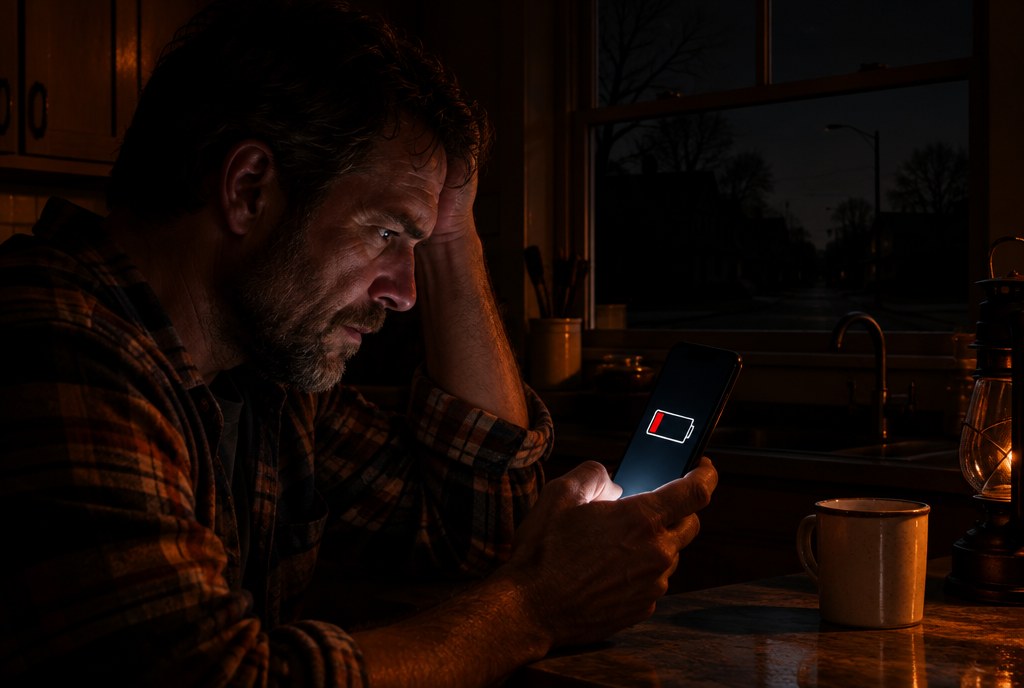
Now repeat the math for the people you would most want to hear from. Your partner. Your kids. Your parents. Odds are their numbers are worse than yours, because they did not read this article.
Here is the part that surprises people: it takes two charged phones to make one call. Your number only matters as much as theirs. If your mother’s phone dies on night one, you are cut off from her no matter how much battery you have.
Power you can keep without the grid
The only way to change the math is to add power that does not depend on the outlet. That means three things: a bank big enough to give multiple charges, a way to top it up without the grid, and one for each person you need to reach.
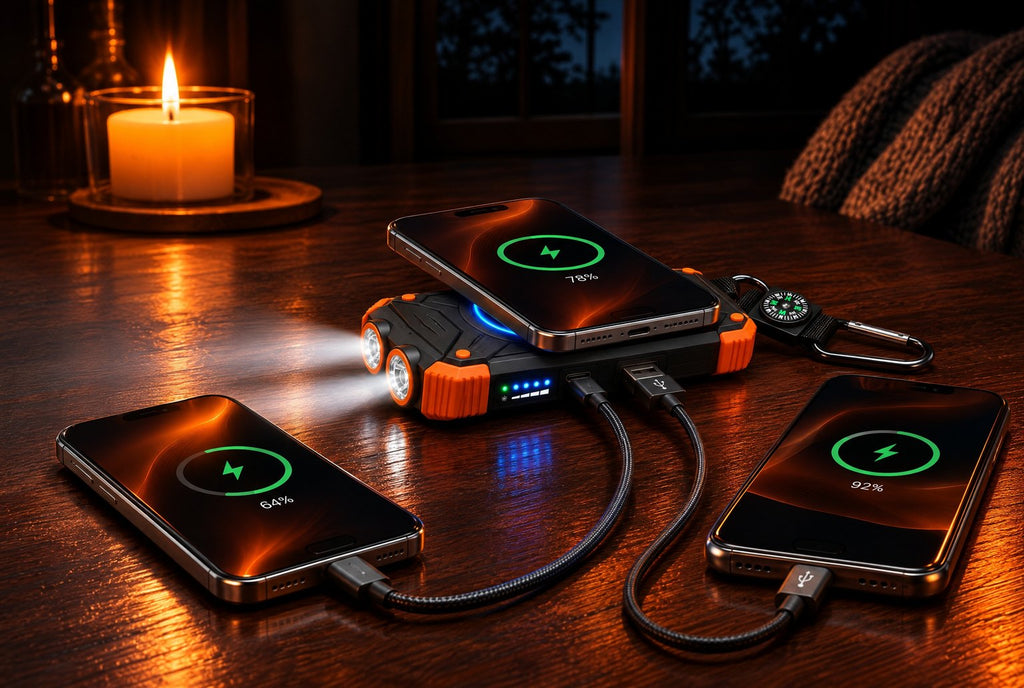
That is what Rivanta is built for. A full bank gives about 2 to 2.5 phone charges, it charges three devices at once, and its built-in solar panel adds a slow top-up in direct sun. Put one in every house on your list and the math changes from about a day to several days, and keeps going a little every time the sun comes out.

- Buy 2, get 1 free: 3 power banks for $109.99 ($36.66 each)
- Buy 3, get 2 free: 5 power banks for $164.99 ($33.00 each)
- 90-day money-back guarantee on every order
Ships with tracking · Ends Nov 30, 11:59 PM CT
Why most backup plans fail on day two
Almost every house has some kind of backup. The trouble is that nearly all of it depends on the one thing that just went away.
- Wall chargers need the grid. Useless the second the lights go out.
- Regular power banks give you one refill. Then they need an outlet to recharge, and there isn’t one.
- Car chargers need gas and a running engine. Idling in a closed garage can kill you, so you end up sitting in the driveway in the cold.
- Generators are great for the fridge. They are also loud, need fuel you may not be able to buy, must run outdoors, and do not fit in your pocket or go to your mother’s house.
- Low Power Mode buys you hours, not days.
What actually works is simple: power you charge ahead of time, keep within reach, can carry in one hand, and can top up without an outlet if the outage drags on. That is the job we built Rivanta for.
What Rivanta is, and what it isn’t

- 10,000 mAh (37 Wh): about 2 to 2.5 full charges for most iPhones and Galaxy phones
- 3 devices at once: USB-C 20W fast charge, USB-A and a Qi wireless pad
- Twin LED flashlight with steady, strobe and SOS modes, so you are not burning your phone’s battery for light
- Built-in solar panel for a slow backup top-up in direct sun when there is no outlet
- Built to be thrown in a truck: rubber corners, IPX4 splash-resistant shell, compass carabiner
- Under the 100 Wh carry-on limit for power banks (check your airline)
| Rivanta | Regular power bank | Generator | |
|---|---|---|---|
| Works with no grid | Yes | Until it runs out | While fuel lasts |
| Refills with no outlet or fuel | Solar top-up | No | No |
| Safe indoors, in your hand | Yes | Yes | Outdoors only |
| Charges 3 devices, incl. wireless | Yes | Usually 1 | With adapters |
| Built-in flashlight + SOS | Yes | No | No |
| Price | From $33 each in a bundle | $20–$40 | $400+ |
A five-minute routine that keeps it useful
- Charge it fully the day it arrives.
- Store it in the same spot, one you can find in the dark.
- Top it up every three months. When the clocks change is easy to remember.
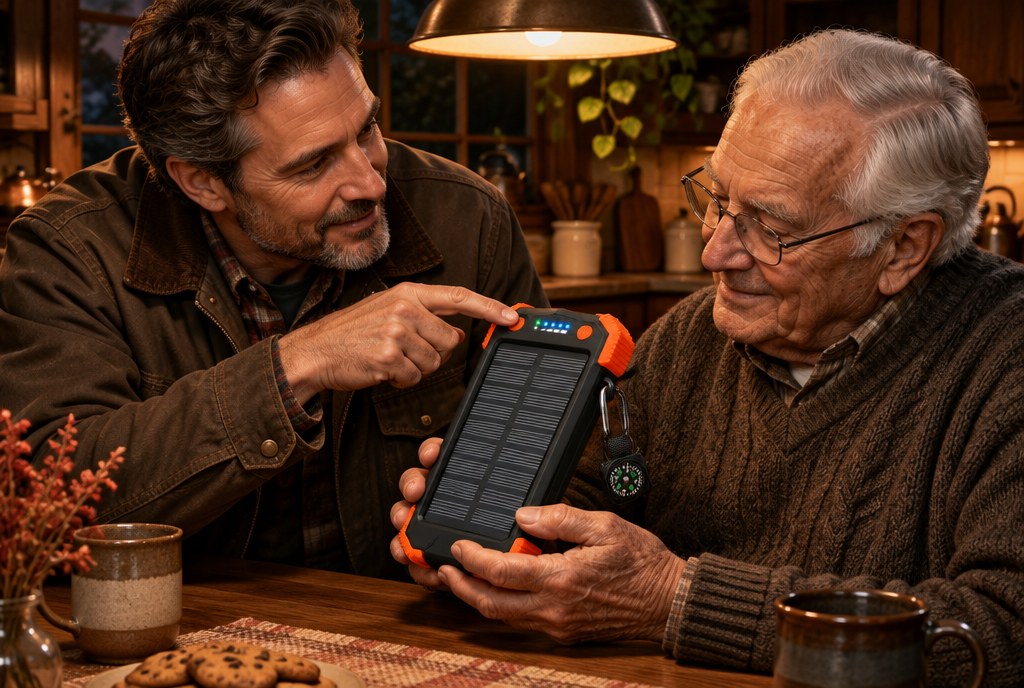
- Give one to each person you would need to reach.
Change the math for your family
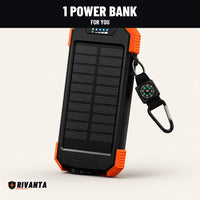 1 Power BankFor you · $54.99 each$54.99
Save 29%MOST POPULAR
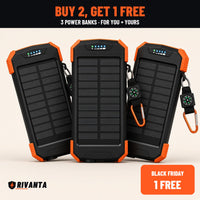 Buy 2, Get 1 FREE3 power banks · $36.66 each$109.99
Save 52%BEST VALUE
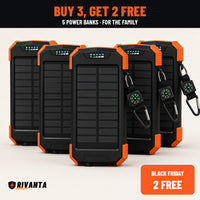 Buy 3, Get 2 FREE5 power banks · $33.00 each$164.99
Save 57%
Tap a bundle to go straight to secure checkout · Ships with tracking · 90-day money-back guarantee
Close the gap tonight →90-day money-back guarantee · Black Friday pricing ends Nov 30, 11:59 PM CT
Charge it, use it, switch off your main breaker for an hour and live on it. If it is not for you, send it back within 90 days for a full refund.


